This Sunday represents an interesting meeting place liturgically, because this Sunday, February 1st is both the Forefeast of the Presentation of our Lord in the Temple, as well as the beginning of the Triodion.
So, in one sense, we are looking back to Our Lord’s Nativity, because the Presentation (40 Days after Christmas, February 2nd) in many ways concludes that chapter of the story. After the quiet majesty of His Birth & Adoration, followed by His Circumcision & Naming, now, His mother, Mary, and His guardian, Joseph, further fulfill the Law, bringing Him for dedication to the Temple. They are met by the Prophet Simeon, who spent many years studying the Messianic prophecies, praying piously to God that he be allowed to remain alive until He has seen the Christ. Therefore, Simeon is overcome with emotion, taking the Child in his arms and saying, “Lord, now let Your servant go in peace according to Your promise, because my eyes have seen Your salvation which you have prepared before the face of all peoples, a light to bring revelation to the Gentiles, and the glory to your people Israel" (Luke 2:29-32).
How strange, in our rational minds, to be at once preparing ourselves for the commemoration of the Christ Child held in Simeon’s arms, but also, at the same time recalling the Lenten spirit of our Lord’s Parable of the Publican and the Pharisee. The Pharisee, respected in the eyes of men, justifies himself before God, while insulting the tax collector; while the tax collector does not even dare to look at heaven, only weeping as he prays, “God, be merciful to me a sinner!” (Luke 18:13) However, let us look closer at the virtues these two events share.
Looking past the comforting image of Simeon holding a young Christ, and the beautiful prayer we use to conclude Vespers, remember how Simeon turns to Mary, continuing to prophesy: “Behold, this child is set for the fall and rising of many in Israel, and for a sign that is spoken against (and a sword will pierce through your own soul also), that thoughts out of many hearts may be revealed” (Luke 2:34-35). Here, is the point of connection between these commemorations: our Lord humbled Himself to take on our flesh, and to be held in the arms of one of His own Priests. Such humility is unfortunately, not common, as we can see from the “prayers” of the Pharisee. More to the point, Christ’s insistence on our need to assume the same kind of self-denying humility as the Publican is still treated as a kind of threat: it reveals the thoughts of many hearts, today, as it did in Israel, especially among those who do not wish to fall from earthly power.
May we use the commemoration of the Forefeast of the Presentation & the Sunday of the Publican and the Pharisee to soften our hearts: imitating the tax collector’s humility, sincerely repenting of our own faults, and trying to forgive our brothers and sisters. Only then will we progress in our journey to share the same innocent and humble spirit, shown by our Lord, both as a babe in Simeon’s arms and as the God-Man on the Cross.
+SEVASTIANOS
Metropolitan of Atlanta
Homily on Saint Andrew the Apostle (Metr. Hierotheos of Nafpaktos)
By Metropolitan Hierotheos of Nafpaktos
November 30, 2013
The historical and megalonymos city of Patras honors today and praises its patron and protector saint, the First-Called Apostle Andrew.
For the lovers of feasts of this Local Church it is a bright festival, but also for the entire Orthodox Church, especially the Ecumenical Patriarchate, since Saint Andrew is the founder of that Church. But Patras has the great honor of being the city of his glorious martyrdom, which he irrigated with his sanctified blood.
Invited as we are today by Metropolitan Chrysostomos of Patras, we also keep the festival with you and celebrate with you and we taste of this great joy, communing of the holy Bread and the holy Blood of Christ, and to me was given the honor to speak before this crowd of pious Christians.
I will highlight two points connected with the person and work of the First-Called Apostle Andrew.
The first is that in the life of Saint Andrew there are tightly connected calling, discipleship and theology. Saint Andrew was called to the apostolic office, he was a disciple for three years close to Christ, he participated in the Cross and Resurrection of Christ, he received the Holy Spirit on Pentecost and became a true theologian.
He could repeat what another apostle wrote, the Evangelist John: "That which was from the beginning, which we have heard, which we have seen with our own eyes, which we have gazed upon and touched with our own hands — this is the Word of life. And this is the life that was revealed; we have seen it and testified to it, and we proclaim to you the eternal life that was with the Father and was revealed to us" (1 Jn. 1:1-2).
The same testimony was given by his brother the Apostle Peter, who wrote: "For we did not follow cleverly devised stories when we told you about the coming of our Lord Jesus Christ in power, but we were eyewitnesses of his majesty" (2 Pet. 1:16).
This means that Saint Andrew attended and belonged to the "Theological School of the Apostolic Church." This is a theological school that teaches and transmits empirical theology, and the professor is Christ, who sends the Holy Spirit to educate about Christ in the hearts of people and glorifies the Father, and in this school are students who seek to partake of the glory of the Kingdom of God.
Saint Gregory the Theologian refers to this theology, when he speaks about how the saints theologize: "We theologize in the manner of the Apostles, not that of Aristotle." In other words, the saints theologize with the experience the Apostles had, who were fishermen, but they theologized with the energy of the Holy Spirit and not with their imagination, like the philosophers Plato and Aristotle.
By this we learn, then, that our life in the Church is an initiation into the mysteries of the Kingdom of God, not remaining formal and external, and not merely to satisfy our feelings; we do not live on the surface. Christ Himself said to the Apostle Peter: "Put out into deep water, and let down the nets for a catch" (Lk. 5:4).
The second point is that Saint Andrew, like the other Disciples, having become an empirical theologian, was sent to the whole creation to preach this theology to people and to establish Churches.
Saint John Chrysostom speaking of the Apostle Paul calls him a "heavenly trumpet," a "leader of the bride of Christ," a "gardener of the Church," a mighty "lion," a "fervent" and "manic lover of Christ." This is exactly what distinguishes all the Apostles and of course Saint Andrew, who preached in many places the message of the Resurrection, and arrived in Patras where he was martyred.
The Churches founded by the Apostle Andrew are Apostolic as well as historic Churches, just as this Church of Patras. This means that they never disappeared, having a historical and uninterrupted succession, and are not intermittent Churches.
It seems, then, from the life of the Apostle Andrew, that "Orthodox theology is a historical theology." It is not intellectual, it is not concepts and ideas, it is not imagination, but it is true life that regenerates people and operates in society, in history. Our God is a living God, the God of our Fathers, of the Prophets, of the Apostles and of the Saints, and it acts in history through specific actions (Florovsky). According to the testimony of the Evangelist John: "And the Word became flesh and dwelt among us, and we beheld His glory" (Jn. 1:14).
And everything that is done in the Church is a "theology of events." Christ was incarnate within history and saves people within history. Even here in this blessed and majestic church we have two such "theological events," namely the skull of Saint Andrew, as well as a portion of the cross on which he was martyred. Indeed every Orthodox church is a Pentecost within history.
The Bishop is the one who unites the Apostolic Church with each Local Church. Saint Gregory Palamas says that on the day of Pentecost the Holy Spirit shined upon and illumined the Disciples of Christ and in a divine manner He lit them as lamps and showed them to be "otherworldly and universal luminaries, having words of eternal life, illuminating through them the entire ecumene."
And as light is transmitted sequentially with lamps, and one lamp lights another lamp, the same happens with the Holy Spirit through the ordination of Bishops. Thus, every Hierarch that enters the city for which they are chosen, is a successor of the Apostles, and brings "this grace and the gift of God and through the gospel the illumination of the divine Spirit."
The Bishop who comes into his Metropolis in order to shepherd it is a lamp of Pentecost who transmits the gifts of the Holy Spirit. And those who resist and repel the Bishop, according to Saint Gregory Palamas, "interrupts the grace of God and tears asunder the succession," with the result that they are given over to abominable appointments and various calamities.
The celebration today of our Saint Andrew shows us that within the Orthodox Church we should seek the empirical Theological School of the Apostolic Church, the internal life of the Church and the theology of events, whose guarantor is the Bishop.
Your Eminence holy man of Patras, you are by the grace of God a lit lamp of Pentecost in the Apostolic Church of Patras, which Saint Andrew founded by his teaching and by his blood, and you transmit spiritual gifts. Rejoice in this feast today. Rejoice for your spiritual children who love Christ and the First-Called Apostle Andrew. Rejoice for this Church which is full of the gifts of the Holy Spirit.
And you, blessed Christians, rejoice for the spiritual treasures you have in your city, and especially for the ability to be members of the Orthodox Church, which has an uninterrupted path for twenty centuries and makes saints and even gives you the opportunity to exceed death.
May all of us have the intercessions of the protector of this city, Saint Andrew the First-Called.
Source: Translated by John Sanidopoulos.
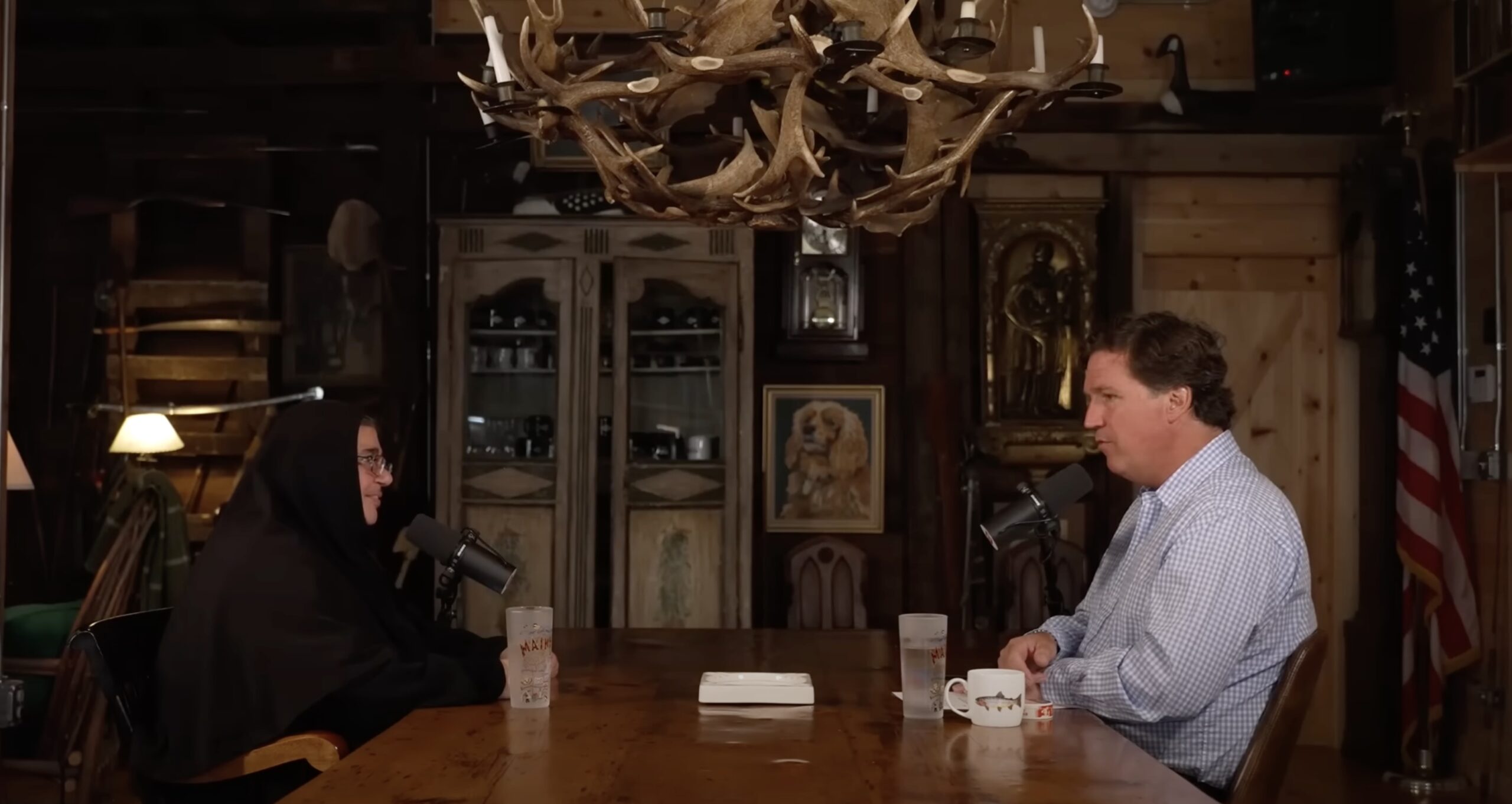
Greek Orthodox Nun Elucidates the Plight of Christians in the Holy Land
Dear Brother Archons and friends of the Archons of the Ecumenical Patriarchate,
Mother Agapia Stephanopoulos, a Greek Orthodox nun who has lived in the Holy Land for many years, recently granted a lengthy and detailed interview to journalist Tucker Carlson on the persecution of Christians in the Holy Land. If you have not watched this interview in its entirety already, I strongly urge you to do so, as Mother Agapia provides a uniquely illuminating perspective on the difficulties that our sister and brothers in the faith face on a daily basis.
As you watch this revealing and often shocking interview, please remain in prayer for the Greek Orthodox Christians of Israel and its environs, and for all the embattled Christians of that war-torn region.
Watch the interview here, and see a full transcript here.
If you need help creating an online giving account, or if you are not receiving communications from the church, please contact the office so we can update your information in our systems. (803) 252-6758 or htgocc@gmail.com
.jpg)